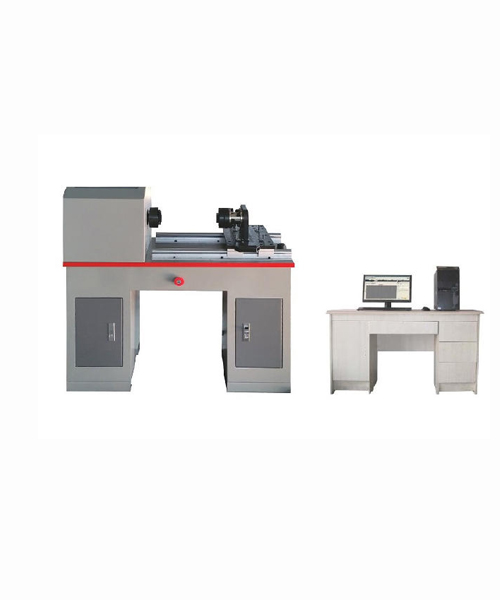
NJW-01 Microcomputer-controlled torsion testing machine
Introduction
The Windows operating platform enables
various closed-loop controls for constant torque and constant torsion angle.
Using a graphical user interface (GUI), the display screen and control panel
can be customized; test speed and various control parameters can be set;
real-time display of torque, screw-in torque, screw-out torque, minimum
breaking torque, maximum torque, torsional strength, minimum breaking torsion
angle, torsion speed, and peak torque can be displayed; real-time display of
various relevant parameter graphs during the test process can be displayed; and
system diagnostics can be performed and the results displayed.
The entire machine utilizes a fully digital
AC servo control system and an FTS precision testing system. An optical encoder
acquires the torsion angle of the sample, and a high-precision dynamic torsion
sensor detects the torque of the sample.
The Windows operating platform enables
various closed-loop controls for constant torque and constant torsion angle.
Using a graphical user interface (GUI), the display screen and control panel
can be customized; test speed and various control parameters can be set;
real-time display of torque, screw-in torque, screw-out torque, minimum
breaking torque, maximum torque, torsional strength, minimum breaking torsion
angle, torsion speed, and peak torque can be displayed; real-time display of
various relevant parameter graphs during the test process can be displayed; and
system diagnostics can be performed and the results displayed.
The entire machine utilizes a fully digital
AC servo control system and an FTS precision testing system. An optical encoder
acquires the torsion angle of the sample, and a high-precision dynamic torsion
sensor detects the torque of the sample.
Standard:
JB/T9370 -- 2015 《Technical conditions of torsion
tester》
Gb10128-2007 《Metallic
materials - Test method for torsion at room temperature》
JJG269-2006 《Verification
regulation of torsion tester》
ASTM F543《Standard Specification and Test Methods for Metallic Medical Bone
Screws》
Product description:
1. Main Unit: Utilizes a horizontal
structure with a frame design to ensure overall rigidity. Sample installation
and disassembly are convenient and quick.
2. Linear Guide Rail: The nut is fixed
to a linear circular rail, allowing for easy movement.
3. Drive System: Driven by a fully
digital AC control system, offering a wide speed adjustment range and uniform,
stable loading.
4. Transmission System: Employs a servo
motor for direct drive, ensuring uniform, stable, and precise transmission.
Manual adjustment is possible within the lateral range.
5. Measurement and Display System: The
machine uses an encoder to acquire the sample's torsional angle and a
high-precision dynamic torque sensor to acquire the sample's torque. The
computer screen displays the sample's torque, torsional angle, torsional
deformation, and various curves.
6. Software Operation: The control mode
employs an intelligent expert setting system, allowing users to customize the
test process control according to their specific requirements, automatically
completing the test. 7. FTS Precision Testing System:
1) Automatic Zeroing: Upon receiving
the test start command, the main control computer automatically zeroes the
measurement system.
2) Testing Process: The entire testing
process, including measurement, display, and analysis, is completed by the
microcomputer.
3) Testing Software: Windows user
interface with simple and convenient menu prompts and mouse selection. 4)
Display Mode: Data and curves are dynamically displayed during the test, with
automatic curve scaling. Selectable curves include torque-time, torque-torsion
angle, and torsion angle-time.
5) Result Reproduction: Test results
can be freely accessed and re-analyzed.
6) Curve Traversal: After the test, the
force and deformation data at each point on the test curve can be found using
the mouse, facilitating the calculation of test parameters for various
materials.
7) Result Comparison: Multiple sample
characteristic curves can be overlaid with different colors, reproduced, and
locally magnified for comparative analysis of a group of samples.
8) Batch Testing: For samples with
identical parameters, a batch of samples can be tested sequentially after a
single setting.
9) Test Report: Test data is
automatically processed and displayed, and a test report conforming to national
standards is printed, including the test date, number, material, torsion, etc.
Test reports can be programmed and printed according to user-specified formats.
10) Overload Protection: Features
overload protection: automatic shutdown when exceeding the maximum load by
3-10%, with electronic and mechanical dual-level protection to effectively
prevent damage to sensors from overload.
11) Automatic Diagnosis: The system
features automatic diagnostics, periodically checking the measurement and drive
systems for overvoltage, overcurrent, and overtemperature. In case of
abnormalities, it automatically shuts down and implements protection measures.
12) Automatic Data Saving: Test data
and conditions are automatically saved, preventing data loss due to sudden
power outages or forgetting to save.
13) All permitted operations can be
performed on the testing machine's control panel or via a connected computer.
14) It features automatic tracking and
measurement of torsional force and torsional angle, loading speed indication,
and peak value hold.
15) An independent FTS digital data
acquisition and processing system allows for computer control, acquisition,
analysis, and processing of test data. Test data and curves are dynamically
displayed throughout the test. The test data is automatically processed and
displayed by a microcomputer, generating torque-angle and torque-time curves.
It connects to a printer and prints test reports that conform to national
standards, including test date, number, material, and torsional strength. It
features automatic tracking and measurement of torsional force and torsional
angle, loading speed indication, and peak value hold.
16) The freely movable worktable is
suitable for specimens of various lengths.
17) Pre-installed with the FTS torsion
testing machine software package under the Windows operating system, it can
perform tests according to national standards or user-provided standards, and
also meets ASTM, DIN, JIS, ISO, EN, and other standards.
18) The control mode adopts an
intelligent expert setting system, allowing users to customize the test process
control mode according to their actual requirements, automatically completing
the test.
19) Test data is managed using a
database, facilitating query and maintenance.
8. Safety Protection System: Includes
overload protection, overcurrent protection, overvoltage protection,
undervoltage protection, overspeed protection, and other abnormal protections.
Specifications:
|
Model
|
NJW-01
|
|
Maximum torque of test (Nm)
|
50N.m
|
|
Minimum of reading torque (Nm)
|
0.05
|
|
Maximum of reading torsion angle
|
9999.9°
|
|
Minimum of reading torsion angle
|
0.1°
|
|
Relative error of torque
|
≤±1.0%
|
|
Repetitive relative error of torque
|
≤±1.0%
|
|
Diameter of sample(mm)
|
?10
|
|
Maximum test space of axis (mm)
|
260
|
|
Power
|
220V, 50Hz, 1-Phase
|